Main program for serial-controlled musical organ. More...
#include "includes/CPU.h"#include <avr/io.h>#include <util/delay.h>#include "includes/pinDefines.h"#include "includes/scale16.h"#include "includes/organ.h"#include "includes/pre_defined_songs.h"#include "includes/USART.h"
Go to the source code of this file.
Macros | |
| #define | ARRAY_SIZE(x) (sizeof(x) / sizeof((x)[0])) |
| Calculate the number of elements in a static array at compile time. | |
Functions | |
| int | main (void) |
| Main program entry point. | |
Variables | |
| uint16_t | currentNoteLength = Q |
| Current note duration in milliseconds. | |
| const uint16_t | notes [] |
| Array of musical notes mapped to keyboard keys. | |
Detailed Description
Main program for serial-controlled musical organ.
- Date
- 2026-04-29
- Version
- 1.1
This program implements a serial-controlled musical organ that plays notes received via USART on an ATmega168 microcontroller. It maps keyboard keys to musical notes and allows dynamic control of note duration through serial commands. The program also supports playing pre-programmed songs.
Hardware Requirements
- ATmega168 microcontroller (or compatible)
- Buzzer/Piezo element connected to BUZZER_PIN (defined in pinDefines.h)
- USART connection (typically via USB-to-Serial converter like FTDI)
- 16 MHz external crystal or calibrated internal oscillator
Dependencies
- CPU.h: CPU-specific configurations (F_CPU, BAUD)
- pinDefines.h: Pin definitions for buzzer (BUZZER_DDR, BUZZER_PIN)
- scale16.h: Musical note frequency definitions (C4, G4, Q, H, etc.)
- organ.h: Note playing functions (playNote, rest)
- pre_defined_songs.h: Pre-programmed songs
- USART.h: Serial communication functions (initUSART, printString, etc.)
Serial Commands
| Key | Action | Mode |
|---|---|---|
| a, s, d, f, g, h, j, k, l, ;, ' | White keys (natural notes) | Musical |
| w, e, t, y, i, o, p | Black keys (sharp notes) | Musical |
| [ | Set short note duration (250ms) | Control |
| ] | Set long note duration (500ms) | Control |
| 1 | Play "Twinkle Twinkle Little Star" | Song |
| 2 | Play "Imperial March" (Star Wars) | Song |
Musical Note Mapping
The following keyboard keys correspond to musical notes:
White Keys (Natural Notes):
| Key | Note | Frequency | Octave |
|---|---|---|---|
| a | G4 | 392 Hz | 4th |
| s | A4 | 440 Hz | 4th |
| d | B4 | 494 Hz | 4th |
| f | C5 | 523 Hz | 5th |
| g | D5 | 587 Hz | 5th |
| h | E5 | 659 Hz | 5th |
| j | F5 | 698 Hz | 5th |
| k | G5 | 784 Hz | 5th |
| l | A5 | 880 Hz | 5th |
| ; | A#5 | 932 Hz | 5th |
| ' | C6 | 1047 Hz | 6th |
Black Keys (Sharp Notes):
| Key | Note | Frequency | Octave |
|---|---|---|---|
| w | G#4 | 415 Hz | 4th |
| e | A#4 | 466 Hz | 4th |
| t | C#5 | 554 Hz | 5th |
| y | D#5 | 622 Hz | 5th |
| i | F#5 | 740 Hz | 5th |
| o | G#5 | 831 Hz | 5th |
| p | B5 | 988 Hz | 5th |
Note Durations
- Q: Quarter note (250ms) - Short mode, faster tempo
- H: Half note (500ms) - Long mode, slower tempo
- currentNoteLength: Global variable tracking current duration mode
Usage
- Hardware Setup:
- Connect buzzer to BUZZER_PIN (see pinDefines.h)
- Connect USB-to-Serial adapter to USART pins (PD0/RX, PD1/TX)
- Software Setup:
- Compile and flash to ATmega168
- Open serial terminal (9600 baud, 8N1)
- Operation:
- Press letter keys (a, s, d, f, etc.) to play notes
- Press '[' or ']' to change note duration
- Press '1' to play Twinkle Twinkle Little Star
- Press '2' to play Imperial March
Flow Control & Blocking Behavior
receiveByte()blocks until a character is receivedplayNote()blocks for the duration of the note (250-500ms)play_twinkle_little_star()blocks for ~10-15 secondsplay_imperial_march()blocks for ~30 seconds- Serial commands are ignored during song playback
Memory Usage Analysis
- Notes array: 18 notes × 2 bytes = 36 bytes
- Keys array: 18 keys × 1 byte = 18 bytes
- Stack usage: ~50 bytes (function calls, local variables)
- Total RAM usage: ~100-150 bytes (ATmega168 has 1KB)
- Flash usage: ~2-3KB (ATmega168 has 16KB)
Known Issues & Limitations
- Blocking playback: No serial input accepted during note/song playback
- Buffer overflow: Rapid key presses may be lost (no input queue)
- No interrupt handling: UART interrupts not used
- Fixed tempo: Songs use hardcoded durations (Q=250ms, H=500ms)
- No volume control: Buzzer operates at fixed volume
Future Improvements
- [ ] Implement circular buffer for UART RX (queue system)
- [ ] Add non-blocking timer-based note generation
- [ ] Support for multiple octaves (octave shifting)
- [ ] Volume control (PWM on buzzer)
- [ ] More pre-programmed songs
- [ ] MIDI input support
- [ ] LCD display for current settings
License
This program is open source. Feel free to modify and distribute.
- See also
- pre_defined_songs.c Song implementations
- organ.c Note generation implementation
- USART.c Serial communication implementation
Definition in file main.c.
Macro Definition Documentation
◆ ARRAY_SIZE
| #define ARRAY_SIZE | ( | x | ) | (sizeof(x) / sizeof((x)[0])) |
Calculate the number of elements in a static array at compile time.
- Parameters
-
x The array to calculate size for
- Returns
- Number of elements in the array
- Note
- This macro only works with actual arrays, not pointers
- Warning
- Using on pointers will give incorrect results
Function Documentation
◆ main()
| int main | ( | void | ) |
Main program entry point.
- Returns
- int Program exit status (never reached in embedded systems)
Initializes the buzzer pin and USART communication, then enters an infinite loop that processes incoming serial commands and plays corresponding musical notes or songs.
Initialization Steps
- Configure buzzer pin as output (BUZZER_DDR)
- Initialize USART communication (initUSART)
- Display control instructions via serial (printString)
- Enter main processing loop
Main Loop Operation
The main loop continuously:
- Receive: Waits for a character via
receiveByte()(blocking call) - Echo: Transmits the character back via
transmitByte() - Check Notes: Maps key to note using parallel arrays
- Process Commands: Handles special characters ([, ], 1, 2)
- Default: Plays a rest for unassigned keys (ignores CR/LF)
- Delay: Small delay (10ms) to prevent CPU saturation
Command Priority
- Musical notes (a-z keys) - Highest priority
- Song triggers ('1', '2')
- Mode controls ('[', ']')
- Rest (all other characters) - Lowest priority
Error Handling
- Unrecognized commands (except CR/LF) trigger a rest (silence)
- No error messages are sent to avoid serial clutter
- Invalid note keys are silently ignored (no error feedback)
@performance Performance Characteristics
- Note latency: ~1-2ms (UART receive + processing)
- Note jitter: Low (deterministic blocking delays)
- CPU usage: 100% during note playback (busy-wait)
- Memory footprint: ~150 bytes RAM, ~3KB flash
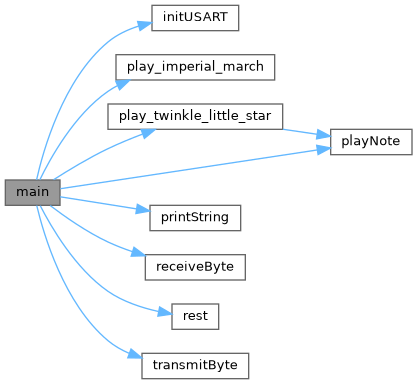
- See also
- playNote() Function that generates tones
- play_twinkle_little_star() Song implementation
- play_imperial_march() Song implementation
- rest() Silence generation function
< Received character from USART
< Flag indicating if character was a valid note
< Loop counter for key mapping
Keyboard key mapping array
Maps physical keyboard keys to musical notes. Must maintain same order as notes[] array.
The array includes:
- White keys: a, s, d, f, g, h, j, k, l, ;, '
- Black keys: w, e, t, y, i, o, p
Total of 18 keys covering 2 octaves (G4 to C6)
- Invariant
- ARRAY_SIZE(keys) == ARRAY_SIZE(notes)
Step 1: Receive character from USART
- Note
- This function blocks until a character is received
Step 2: Echo character back to sender
Useful for debugging and providing visual feedback
- Note
- Can be disabled to reduce serial traffic
Step 3: Check if character is a valid musical note
Iterates through keys array and plays corresponding note if a match is found.
Step 4: Process non-note commands
Handles control characters, song triggers, and ignores unwanted characters.
Handle all other characters
Ignore carriage return and line feed (common from terminal) For all other characters, play a rest (silence) to indicate the key was received but invalid.
Step 5: Small delay to prevent CPU saturation
Allows other tasks (if any) to run and prevents the main loop from consuming 100% CPU when idle. A value of 10ms is sufficient for smooth operation.
Definition at line 455 of file main.c.
References ARRAY_SIZE, BUZZER_DDR, BUZZER_PIN, currentNoteLength, H, initUSART(), notes, play_imperial_march(), play_twinkle_little_star(), playNote(), printString(), Q, receiveByte(), rest(), and transmitByte().
Variable Documentation
◆ currentNoteLength
| uint16_t currentNoteLength = Q |
Current note duration in milliseconds.
Global variable that stores the currently selected note duration. Initialized to Q (quarter note, typically 250ms) for shorter notes. Modified by '[' (short mode) and ']' (long mode) commands.
- Note
- Changing this variable affects ALL subsequent notes played
- Warning
- Does NOT affect songs that use hardcoded durations
Definition at line 371 of file main.c.
Referenced by main().
◆ notes
| const uint16_t notes[] |
Array of musical notes mapped to keyboard keys.
This array contains frequency values (timer compare values) for notes corresponding to keys in the same position in the keys array.
Index Mapping:
| Index | Key | Note | Frequency |
|---|---|---|---|
| 0 | a | G4 | 392 Hz |
| 1 | w | G#4 | 415 Hz |
| 2 | s | A4 | 440 Hz |
| 3 | e | A#4 | 466 Hz |
| 4 | d | B4 | 494 Hz |
| 5 | f | C5 | 523 Hz |
| 6 | t | C#5 | 554 Hz |
| 7 | g | D5 | 587 Hz |
| 8 | y | D#5 | 622 Hz |
| 9 | h | E5 | 659 Hz |
| 10 | j | F5 | 698 Hz |
| 11 | i | F#5 | 740 Hz |
| 12 | k | G5 | 784 Hz |
| 13 | o | G#5 | 831 Hz |
| 14 | l | A5 | 880 Hz |
| 15 | p | B5 | 988 Hz |
| 16 | ; | A#5 | 932 Hz |
| 17 | ' | C6 | 1047 Hz |
- Note
- The order MUST match the keys array in main() function
- Warning
- Changing this array requires updating keys array to match
- See also
- keys Keyboard key mapping array
- scale16.h Note definitions
- Examples
- /home/luka/WORK/Programming/ARDUINO/AVR-Square-Wave-Organ/src/main.c, and /home/luka/WORK/Programming/ARDUINO/AVR-Square-Wave-Organ/src/pre_defined_songs.c.
Definition at line 406 of file main.c.
Referenced by main().